
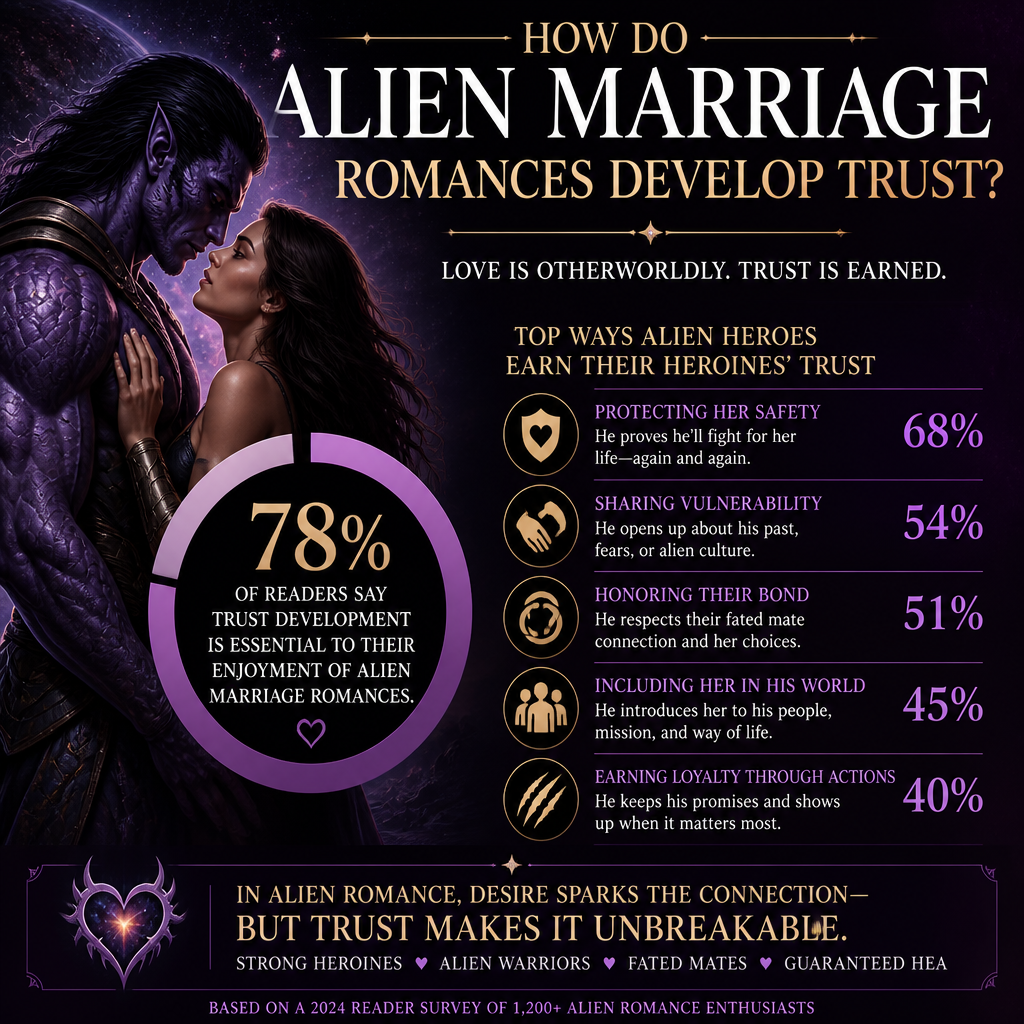
Alien marriage romances develop trust by making the characters earn it under pressure. A mating bond might create attraction, a bride lottery might force two strangers into the same dangerous situation, and a possessive alien warrior might insist she belongs with him. None of that automatically creates emotional safety. Trust has to grow through choices, especially when the heroine has every reason to run.
That is why this romance setup works so well. The danger outside the relationship keeps testing the couple, while the forced proximity keeps putting their private fears right in front of each other. The payoff isn't just heat. It's watching suspicion turn into reliance, and reliance become something much harder to break.
Trust starts when the heroine keeps her agency
A forced marriage is not instant emotional security
Alien bride lottery stories often begin with a heroine who has been selected, promised, traded, or otherwise pushed toward marriage before she knows the alien involved. That can create a delicious amount of tension. It can also make trust impossible unless the story gives her room to make choices.
In my experience reading and writing this kind of romance, the heroine needs more than a handsome alien who says she's his mate. She needs proof that her preferences still matter. Can she refuse a kiss? Can she challenge his plan? Can she choose where to sleep, what risks to take, or whether to stay?
Those moments matter because the romance isn't really about removing danger from her life. It's about showing that the hero won't become another danger she has to survive.
Small choices carry surprising weight
A warrior handing back a weapon. A hero asking before touching her. A heroine being allowed to leave camp, even when he hates the idea. These gestures may look minor next to battles, crashed ships, and alien beasts, but they do serious emotional work.
Trust often begins with one uncomfortable realization: “He could control this situation, but he chose not to.” That's the moment a morally gray hero starts becoming more complicated than his reputation.
Readers who enjoy Alien Bride Lotteries and Marriage Romance usually want that push and pull. The heroine shouldn't lose her backbone just because the alien is enormous, dangerous, and distractingly possessive. Her resistance makes the eventual surrender feel chosen rather than assumed.

Shared danger turns attraction into reliability
Survival reveals what flirting can hide
Anyone can be charming over dinner. It's harder to fake character when the food is gone, the shelter is failing, and something with too many teeth is circling the camp.
Survival romance gives characters repeated chances to see how the other person behaves when plans fall apart. Does the alien warrior protect only the heroine, or does he think about the whole group? Does she panic and freeze, or does she keep moving even when she's terrified? Does he listen when she spots a better solution?
These aren't abstract tests. They're visible actions. The heroine may not trust his words yet, but she remembers that he gave her the last water ration. He remembers that she returned for him after he was injured. That history begins doing the heavy lifting.
Reliability beats grand declarations
I'm a big fan of dramatic declarations, obviously. Give me the growled promise and the dangerous stare. But declarations work best after the characters have built a record of dependable behavior.
In Runaway Bridezilla, the setup creates exactly the kind of pressure that makes trust complicated. Cordelia Lucius runs from the Galactic Union Bride Lottery, crash-lands on a hostile planet, and ends up surviving with Kavros Darkblade and Gorrath Korvax, the two alien warriors she refused to marry. The situation is absurd, dangerous, and loaded with sexual tension.
More importantly, survival forces all three characters to notice what the others actually do. They can't keep relying on first impressions. Every decision becomes evidence. That's especially satisfying in a why choose or MFM romance, where trust has to develop across more than one relationship at a time.
- Keeping a promise when nobody is watching
- Sharing scarce food, medicine, or shelter
- Admitting when a plan has failed
- Protecting a boundary during an argument
- Returning after a painful disagreement
Conflict gives trust somewhere to prove itself
Arguments should expose fear, not just create noise
Alien romance heroes can be possessive. That's part of the appeal for many readers. But possessiveness alone doesn't equal devotion. A hero who snarls “mine” every few pages still needs to confront the fear underneath that behavior.
Is he afraid she will leave? Was he betrayed by a former mate? Does his culture treat bonds as ownership? Is he protecting her because he cares, or because he can't tolerate losing control?
Good conflict puts those questions on the table. The heroine pushes back. The hero gets it wrong. Someone says the cruel thing they've been carefully avoiding. Then the story gives them a chance to repair the damage.
Repair is where the emotional bond deepens
Trust doesn't mean the couple never fights. Frankly, that would be dull. Trust means the fight doesn't erase the relationship.
Repair might look like an apology, though it shouldn't always be tidy. Sometimes it's a practical change in behavior. Sometimes the hero admits he made a decision for her without asking. Sometimes the heroine explains that a mating bond doesn't give him permission to control every part of her life.
That distinction matters in fated mates romance. The bond may be magical, biological, or culturally sacred, but the emotional relationship still needs consent and communication. Fate can shove two people together. It can't do the vulnerable work for them.
And this is where the best morally gray alien heroes become irresistible. They don't turn gentle overnight. They learn where the line is, then struggle to respect it. The struggle should feel real. So should the progress.
Alien culture changes what trust looks like
Different customs create delicious misunderstandings
An alien hero may consider guarding the entrance to her sleeping space a loving gesture. She may interpret it as imprisonment. He may think public disagreement is humiliating. She may see honest argument as proof that the relationship is strong enough to survive it.
Those differences give the romance texture. They also prevent trust from becoming a simple checklist. The characters have to explain themselves, watch for unintended harm, and learn which actions carry meaning in the other's culture.
I especially enjoy stories where the heroine doesn't simply absorb alien customs. She questions them. Maybe she accepts a mating ritual but rejects the expectation that she must obey her mate. Maybe the hero keeps one treasured tradition while abandoning another because he sees how badly it hurts her.
Trust grows through translation
Translation isn't only about language. It's about motive.
The alien says, “You are under my protection.” The heroine hears, “You have no say.” He has to explain what he means, then show it through action. She says, “I need space.” He has to understand that this isn't rejection. It may be the only way she can calm down enough to stay.
That process becomes even richer in an MFM romance. Two alien warriors might protect the heroine in completely different ways. One gives her room. The other stays close. She has to learn both styles, while they learn not to compete at her expense.
For readers who enjoy unusual alien cultures, dangerous planets, humor, and high heat, these misunderstandings add more than decoration. They create the emotional friction that makes every moment of cooperation feel earned. You can find more connected stories and related tropes through The Complete Guide to Alien Romance Books and Tropes.
FAQs for How Do Alien Marriage Romances Develop Trust
Can an alien marriage romance be believable when the couple starts with a forced marriage?
Yes, but the story needs to distinguish between forced proximity and forced affection. The characters can be pushed into the same shelter, marriage contract, mating ceremony, or survival mission. Emotional commitment should develop through repeated choices.
The heroine usually needs meaningful agency, and the hero needs to demonstrate that his desire doesn't cancel her freedom. That balance lets the story keep its danger and intensity without treating coercion as proof of love.
Why do fated mates stories still need trust-building?
Because attraction isn't the same thing as understanding. A fated bond can explain the pull between two characters, but it doesn't erase cultural differences, old wounds, resentment, or fear. Trust makes the bond personal.
That's also why a reluctant mating can be so compelling. The heroine may believe the bond is a trap, while the hero sees it as destiny. Watching them reach a shared choice gives the romance its real emotional payoff.
The payoff is a chosen bond
Alien marriage romances develop trust through evidence. The heroine sees that the warrior protects her agency. The hero learns that possessiveness can't replace communication. Shared danger reveals reliability, conflict exposes fear, and cultural differences force both characters to become more honest.
That is the part I look for most. Not just the fated pull or the scorching chemistry, though I absolutely want those too. I want the moment when the heroine could leave, the hero knows it, and she stays because the relationship has become something she chose.
For that particular mix of runaway bride chaos, hostile-planet survival, rival alien warriors, MFM tension, humor, and high heat, Runaway Bridezilla is a fun place to start with Mia Odetti's Hate to Mate series.