
Survival romance on dangerous alien planets works because the romance has to matter before anyone feels safe. The heroine isn’t simply attracted to a brooding alien warrior across a crowded ballroom. She’s cold, injured, hunted, or stranded. Maybe the shelter has one functioning door. Maybe the food is poisonous to humans. Maybe the two possessive warriors who can keep her alive are the same men she was determined to escape.
That pressure creates a very particular reading experience. You get sexual tension, forced proximity, alien culture, danger, humor, and a romantic payoff that feels earned. For readers who enjoy spicy science fiction romance, fated mates, bride lotteries, and MFM or why-choose dynamics, a hostile planet can act like a pressure cooker. Nobody gets to pretend the attraction isn’t there for very long.
Why dangerous planets make the romance sharper
A dangerous setting gives every romantic choice weight. A heroine might need an alien warrior’s body heat overnight, his knowledge of edible plants, or his ability to fight off a predator. That doesn’t automatically make the attraction romantic. In fact, the best books keep that distinction clear. Survival creates contact. Trust has to grow from what the characters do with it.
I look for three kinds of danger working together: physical danger, social danger, and emotional danger. Physical danger is the obvious piece. There are predators, storms, poisoned water, unstable terrain, and alien technology nobody understands. Social danger comes from the local culture. A mating bond may be sacred. A bride lottery may carry legal force. The heroine may be treated as a prize, a threat, or a long-awaited answer to a warrior’s prayers.
Emotional danger is where the romance earns its bite. A possessive hero who says “mine” can be delicious in fiction, but readers still want to see whether he respects the heroine’s choices. A morally gray alien hero may lie, threaten, or make ruthless decisions to keep her alive. That can work beautifully. It can also fall flat if the story treats control as proof of love without giving the heroine real agency.
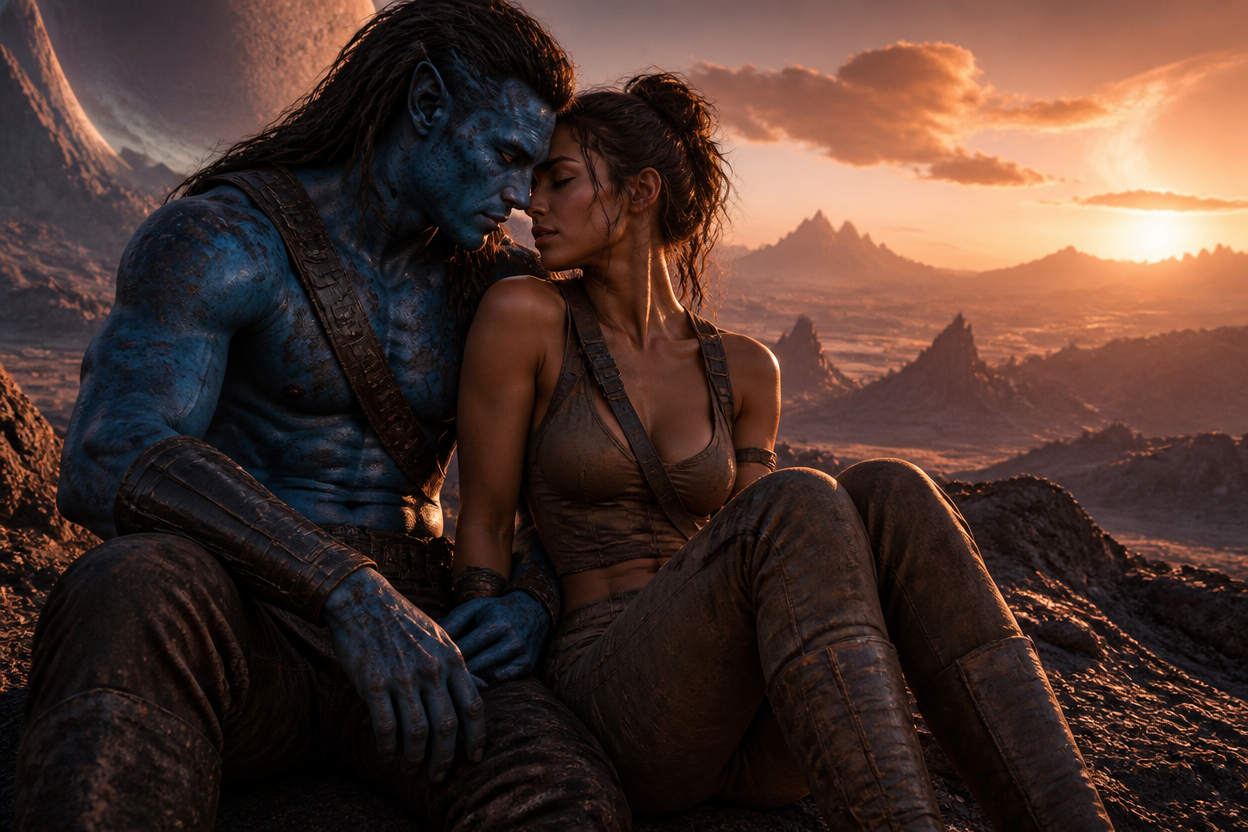
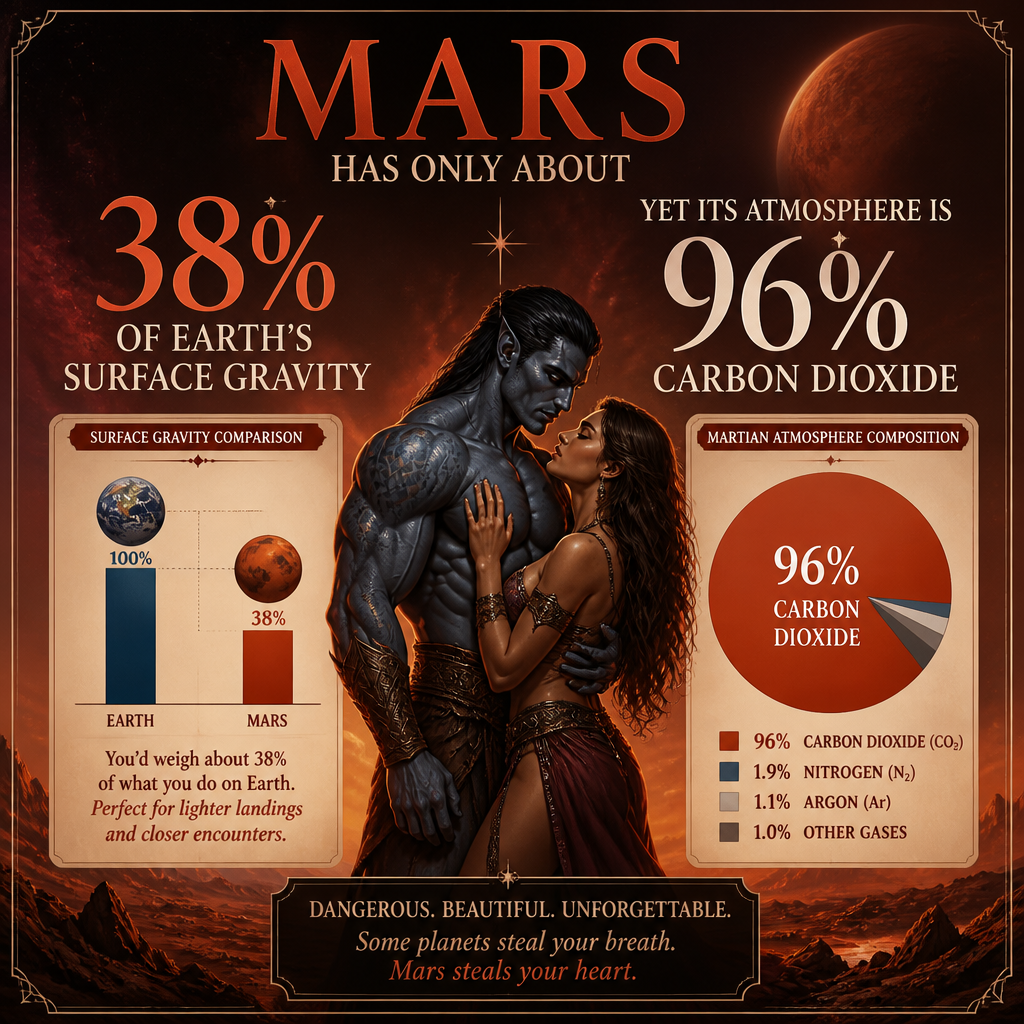
Mars has only about 38% of Earth’s surface gravity, yet its atmosphere is roughly 96% carbon dioxide. That combination is a useful reminder of why fictional planets need more than a strange color in the sky. A world can look beautiful and still be immediately hostile to human life.
The survival elements readers actually want
Basic needs with romantic consequences
Food, shelter, water, warmth, and sleep sound practical. In survival romance, they’re also intimacy engines. Sharing the last edible fruit tells you something about a warrior. Giving up the only dry blanket tells you more. A heroine who knows how to repair a transmitter may become essential to the group, while a physically imposing hero may be useless at understanding human medicine.
Those details keep the heroine from becoming cargo. I’m not a fan of stories where she spends the entire book waiting for an alien man to solve every problem. She can be frightened and still be clever. She can need protection in one scene and save everyone’s lives in the next.
The strongest survival plots also allow competence to move around the group. One hero tracks. Another builds shelter. The heroine understands machinery, language, botany, or strategy. In an MFM romance, that division of skills can create a satisfying rhythm because each relationship develops through a different kind of reliance.
A planet that feels like part of the story
The setting shouldn’t be wallpaper. A dangerous planet needs rules. What hunts at night? Which plants imitate human scents? Does the rain burn skin? Can the characters trust the sun, the stars, or the ground beneath them?
Alien worlds become memorable when their hazards affect the emotional plot. A storm might force enemies into a cave. A poisonous river may require one hero to carry the heroine while another searches for a safe crossing. A seasonal migration could separate mates just when they’ve admitted what they want. That’s the good stuff. The environment keeps interfering, and every interruption pushes the relationship somewhere new.
Forced proximity, fated mates, and the consent question
Forced proximity is one of the main pleasures of this subgenre. The characters can’t simply avoid one another until their feelings become convenient. They have to share a shelter, travel together, protect each other, and possibly sleep within arm’s reach of someone they don’t trust.
Fated mates add another layer. The bond may create instant physical awareness, possessiveness, or emotional pull. But instant recognition isn’t the same as instant commitment. I prefer stories where the bond gets the characters into trouble, then the characters decide what to do with it.
This matters even more in alien bride lottery stories. A lottery can provide the inciting problem, but it shouldn’t erase the heroine’s personality. She may resent being selected. She may have good reasons to run. She may be attracted to the warriors and still refuse to be managed by them. That resistance gives the romance somewhere to go.
A typical human sleep cycle lasts about 90 minutes, and people usually move through several cycles during a full night. Survival stories often use interrupted sleep to create vulnerability, but the romantic scene works best when the characters also make a conscious choice to stay close, protect one another, or share the risk.
What makes an alien warrior romance satisfying
Alien warriors tend to arrive with a strong visual and emotional package: enormous bodies, unfamiliar customs, battle scars, unusual anatomy, and a very serious idea of claiming what belongs to them. Readers come for that intensity. They stay for the character beneath the armor.
A convincing warrior hero needs a weakness that isn’t just “he secretly cares.” Maybe he has failed his people before. Maybe he believes tenderness makes him dangerous. Maybe he was raised to see humans as temporary, fragile, or politically useful. The heroine should challenge that belief rather than simply melt it away.
With two heroes, the contrast becomes especially important. One might be controlled and strategic. The other might be impulsive, funny, and openly jealous. One offers safety through planning; the other offers safety through force. Their rivalry creates sparks, but it also has to develop into cooperation. Otherwise the why-choose relationship can feel like two separate romances awkwardly sharing a campsite.
In my experience, the best MFM dynamics give each connection its own flavor. The heroine might share quiet conversations with one warrior and reckless banter with the other. She might trust one first, desire the other first, and understand only later that the three of them function better together. That unevenness feels human.
Where humor belongs in a survival romance
Dangerous planets can become grim very quickly. Humor keeps the story from turning into a nonstop march through mud, blood, and emotional suffering. It also lets the heroine keep her voice when the situation is ridiculous.
Alien culture provides plenty of room for comedy. A warrior may take a sarcastic remark literally. A mating ritual may involve an object the heroine considers completely inappropriate. The heroes may be terrifying to everyone else but baffled by a human phrase or household habit.
The joke shouldn’t erase the danger. It should relieve pressure for a moment, then let the story tighten again. A heroine cracking wise while injured can show resilience. A hero attempting to cook alien meat and nearly poisoning the group can reveal vulnerability. Those scenes make the characters feel like people rather than trope delivery systems.
Runaway Bridezilla and the appeal of the hostile planet
That mix is exactly why I wrote Runaway Bridezilla, the first book in my Hate to Mate series. Cordelia Lucius runs from the Galactic Union Bride Lottery, crash-lands on a hostile planet, and discovers that survival may depend on Kavros Darkblade and Gorrath Korvax. They’re the two alien warriors she refused to marry.
That setup gives the romance immediate friction. Cordelia doesn’t arrive ready to accept a fated bond or admire two possessive warriors. She has an opinion, a temper, and every reason to distrust the system that assigned her a future. Kavros and Gorrath bring different kinds of danger, too. Their rivalry complicates the survival problem, while the hostile planet keeps forcing them into close quarters.
I wanted the story to have the things I love in high-heat alien romance: reluctant mating, sexual tension, alien customs, action, humor, and an MFM relationship with a real emotional arc. The danger isn’t there just to decorate the romance. It tests whether these three people can protect one another without turning protection into ownership.
How to choose your next survival alien romance
Start with the kind of emotional tension you want. A bride lottery usually brings institutional pressure and a heroine fighting for control of her own life. Fated mates bring instinct, recognition, and the question of whether desire can become trust. Forced proximity gives you slow-burn friction and plenty of trapped-together scenes.
Then check the relationship structure. Some books promise a single alien hero with one heroine. Others are openly MFM or why choose, with multiple heroes who each get meaningful page time. Read the description carefully. You’re looking for romantic payoff, not a surprise arrangement that appears halfway through the book.
Pay attention to the heroine’s role in the survival plot, too. Does she make decisions? Does she have useful skills? Can she disagree with the heroes and still be loved? Those questions usually tell me more about the reading experience than a list of tropes.
For more ways to find your next obsession, browse The Complete Guide to Alien Romance Books and Tropes. It covers the wider range of alien romance setups, from fated mates and alien warriors to high-heat series with guaranteed romantic endings.
Why this trope keeps working
Survival romance on a dangerous alien planet works because the external threat makes emotional avoidance difficult. The heroine has to decide whom she can trust. The heroes have to prove that their desire won’t swallow her freedom. And the planet keeps asking whether the three of them can become a team before something kills them.
That’s the appeal in one sentence: danger brings the characters together, but choice makes the romance real. Add a hostile world, two rival alien warriors, a sharp heroine, plenty of heat, and a satisfying happily ever after, and I’m paying attention.