
Alien warrior heroes are popular in romance because they combine danger with devotion. They look capable of surviving a battlefield, a hostile planet, or a political coup. But the real fantasy is what happens when that frightening strength turns toward one person and becomes protection, loyalty, and overwhelming desire.
That contrast hits especially hard in spicy science fiction romance. Readers get the thrill of a dangerous hero without losing the emotional promise of romance: he may be feared by everyone else, but he sees the heroine differently. Add fated mates, forced proximity, survival stakes, and a little possessive behavior, and the story starts pulling several very satisfying buttons at once.
Dangerous to everyone except her
The appeal of controlled power
Alien warriors tend to enter a romance already carrying power. They may be physically stronger, battle-trained, politically feared, or shaped by a culture that treats tenderness as weakness. That creates instant tension. The heroine isn't falling for a harmless nice guy who has never faced a hard choice. She's dealing with someone dangerous.
But danger alone isn't romantic. Not for me, anyway. The appeal comes from watching the hero choose restraint. He could take control of the situation, yet he learns to listen. He could intimidate everyone in the room, yet he handles the heroine's fear with care. That shift makes his affection feel earned.
Possessive alien heroes work best when their intensity has emotional meaning. “You're mine” lands differently when it means “I will stand between you and the entire universe,” not “your choices don't matter.” Readers can enjoy the growl, the territorial instincts, and the jealous tension while still wanting a heroine with agency.
The private softness matters more than the public reputation
Most of the fun comes from the gap between reputation and reality. A warrior might be known as ruthless, cold, or impossible to defeat. Then the heroine notices he remembers how she takes her tea. Or he gives her the safer side of the sleeping space. Or he quietly repairs the weapon she thought she'd lost.
Those small moments do heavy lifting. Big declarations are fun, but private care is what makes the fantasy believable. The hero isn't suddenly a different person. He's still formidable. He simply reveals that his tenderness has always been there, buried under armor and bad decisions.

Alien cultures make familiar romance tropes feel fresh
Fated mates with complications
Fated mates are popular because they promise certainty in a chaotic universe. The bond says these two people belong together, even when common sense says they absolutely shouldn't. That creates delicious resistance. The heroine may reject the bond. The hero may resent it. Neither one gets to pretend the attraction is imaginary.
For readers who enjoy the Complete Guide to Alien Romance Books and Tropes, this is one of the most flexible setups in the genre. A mating bond can be tender, inconvenient, frightening, or hilariously badly timed. It can also expose cultural differences. Perhaps the alien sees the bond as sacred while the heroine sees it as a biological ambush. Honestly, that argument writes itself.
Bride lotteries and forced proximity
Bride lotteries add another layer because the heroine's romantic future is suddenly public property. She may have entered reluctantly, been selected without expecting it, or run from the arrangement entirely. The story gets moving fast because there isn't much room for polite small talk.
Forced proximity makes every reaction sharper. The characters can't cool off after a fight by going home. They may be trapped in a damaged ship, stranded on a hostile planet, or sharing one shelter while pretending they aren't attracted to each other. Alien romance takes familiar pressure-cooker tropes and places them somewhere the walls might also be trying to kill you.
That combination lets romance readers enjoy several tensions at the same time:
- Attraction battling distrust
- Duty colliding with personal choice
- Human assumptions meeting alien customs
- Survival requiring unwanted cooperation
- Fated connection resisting emotional denial
Survival romance turns attraction into action
Why danger raises the romantic stakes
A dangerous planet changes the rhythm of a romance. The characters can't spend three hundred pages circling the same misunderstanding when they need shelter before nightfall. They have to make decisions. Who stands watch? Who gets the last water ration? Who risks a rescue attempt?
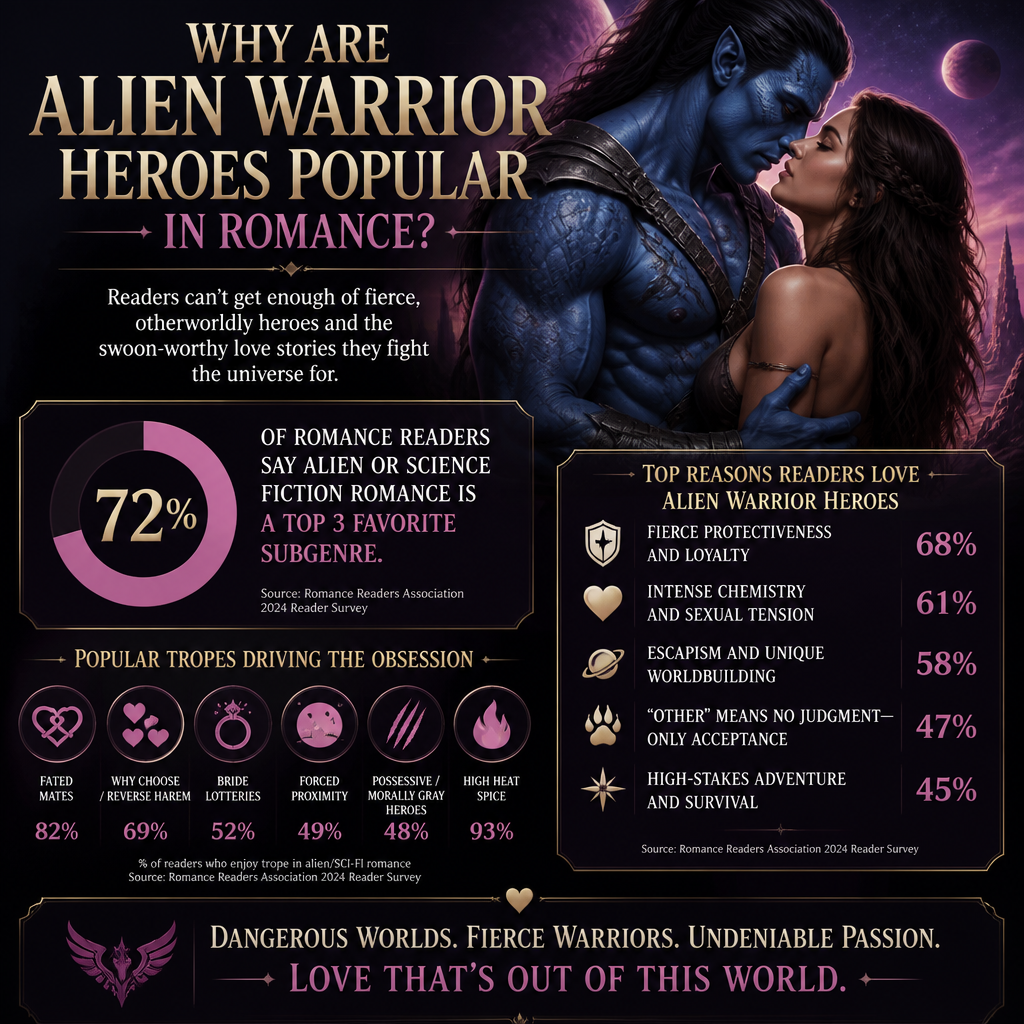
In my experience, those practical choices reveal character faster than long conversations. A morally gray alien hero may lie to everyone else, but he gives the heroine his only working weapon. A proud warrior may refuse to apologize, then walk into a storm because she disappeared. The action makes his priorities visible.
Survival also creates intimacy without forcing it. Sharing body heat isn't just a sexy scene setup. It can be necessary. Treating an injury requires trust. Learning the alien's language may become a matter of life or death. The heroine sees the hero when his usual control breaks down, and he sees her resourcefulness instead of reducing her to someone who needs rescuing.
Why strong heroines belong in these stories
The best alien warrior romances don't make the heroine brave by giving her the hero's personality. She can be frightened and still act. She can hate the situation and still solve the problem in front of her. Maybe she knows engineering, negotiation, medicine, or exactly how to provoke a warrior into making a terrible decision.
That balance matters in MFM and why choose romance, too. When two alien warriors want the same heroine, the story needs more than competition. Each relationship should reveal something different. One hero might offer steadiness. Another brings chaos and heat. The heroine isn't a prize passed between them. Her choices shape the relationship and often force the warriors to change how they understand loyalty.
Morally gray heroes deliver the biggest emotional payoff
The line between ruthless and romantic
Morally gray heroes are compelling because they make readers ask uncomfortable questions. What has he done to survive? Which rules does he follow? Which ones does he break? Would he become a monster for the heroine, or has he already crossed that line?
Romance gives those questions a specific emotional destination. The hero doesn't need to become morally spotless. He needs to become honest about his choices and accountable for the harm he causes. A redemption arc can be messy. Sometimes it should be. A quick apology and one dramatic kiss won't fix everything.
I recommend paying attention to how the book handles consent and agency, especially when the hero is possessive or the setup involves a bride lottery. The heat works better when the heroine has real room to refuse, negotiate, or change her mind. Tension needs resistance. It doesn't need the story to erase her power.
Why readers keep coming back for the series experience
Interconnected alien romance series are satisfying because a reader can fall for one couple while getting glimpses of future trouble. The fierce rival in Book 1 might become the wounded hero in Book 2. A political enemy may turn out to be someone's fated mate. An apparently minor alien custom can become a major source of romantic chaos later.
Runaway Bridezilla, the first book in my Hate to Mate series, plays with that exact energy. Cordelia Lucius runs from the Galactic Union Bride Lottery, crash-lands on a hostile planet, and ends up needing help from Kavros Darkblade and Gorrath Korvax, the two alien warriors she refused to marry. There are survival problems, reluctant bonds, rivalry, humor, and the kind of sexual tension that gets worse when everyone is trying to pretend it isn't happening.
Readers who specifically want alien warriors and morally gray heroes can find more romance setups in Alien Warriors and Morally Gray Heroes. I like this corner of the genre because the emotional conflicts don't stay separate from the adventure. The danger keeps poking the romance until somebody finally admits what they want.
FAQs for Why Are Alien Warrior Heroes Popular in Romance
Why do readers enjoy possessive alien warriors?
Possessive alien warriors offer a heightened version of romantic devotion. The hero may be territorial because of his culture, biology, or warrior training, but readers usually want that intensity balanced with respect for the heroine's choices. The fantasy is not simply that he wants her. It's that he chooses her completely and proves it through action.
Are alien warrior romances always dark?
No. Some are gritty survival stories with morally gray heroes. Others are funny, tender, or surprisingly cozy once the characters stop arguing. Even a dangerous planet can support banter. In fact, humor often keeps a high-stakes romance from becoming emotionally exhausting. The tone depends on the author and the specific series, so I always recommend checking the book's content notes when a darker setup might be an issue.
Why alien warrior romance keeps working
Alien warrior heroes stay popular because they make familiar romance promises feel enormous. Protection becomes interplanetary. A mating bond becomes a challenge to free will. Forced proximity turns into survival. A morally gray hero has to decide whether love is another form of possession or a reason to become better.
That combination gives readers danger, heat, humor, emotional growth, and a guaranteed romantic direction without making every story feel the same. When I want a romance with sharp teeth and a big payoff, this is exactly where I look. And when you want a heroine who crashes into trouble, refuses to behave, and leaves two alien warriors scrambling to keep up, Runaway Bridezilla is a fun place to start.